

Modern industrial environments demand flexibility, reliability, and efficiency from display systems. As production lines, control rooms, kiosks, and automation systems evolve, industrial LCD monitors must support multiple signal sources such as HDMI, VGA, and USB simultaneously. Integrating multiple inputs into a single industrial monitor enables seamless connectivity with diverse equipment, reduces system complexity, and improves operational efficiency.
This article provides a comprehensive overview of how to integrate HDMI, VGA, and USB inputs into a single industrial LCD monitor, covering system architecture, hardware considerations, signal management, and best practices for industrial applications.
Industrial LCD monitors are often deployed in environments where multiple devices—PLCs, industrial PCs, cameras, and legacy systems—must connect to a single display. Supporting multiple video and data inputs offers several advantages:
Compatibility with legacy and modern equipment
Reduced need for external converters or adapters
Simplified system design and maintenance
Improved uptime and operational continuity
By integrating HDMI, VGA, and USB interfaces directly into the monitor, system integrators can future-proof installations while maintaining backward compatibility.
HDMI is widely used in modern industrial systems due to its ability to transmit high-resolution digital video and audio through a single cable. When integrating HDMI into an industrial LCD monitor, key considerations include:
Support for industrial resolutions (e.g., 1024×768, 1280×1024, 1920×1080)
EMI shielding to ensure signal stability
Compatibility with industrial PCs and embedded systems
HDMI is ideal for applications requiring high image clarity, such as machine vision, control dashboards, and HMI systems.
Despite being an analog interface, VGA remains common in industrial environments, especially with older PLCs and control computers. Proper VGA integration requires:
High-quality ADC (Analog-to-Digital Conversion)
Noise filtering for industrial electrical environments
Auto-calibration for phase, clock, and position
Including VGA input ensures that legacy equipment can continue to operate without costly upgrades.
USB integration in industrial LCD monitors serves multiple purposes beyond video input:
USB touch interface for capacitive or resistive touchscreens
USB media playback for standalone operation
Peripheral connectivity (keyboard, mouse, sensors)
In some advanced designs, USB-C can also support video and power delivery, further reducing cable complexity.
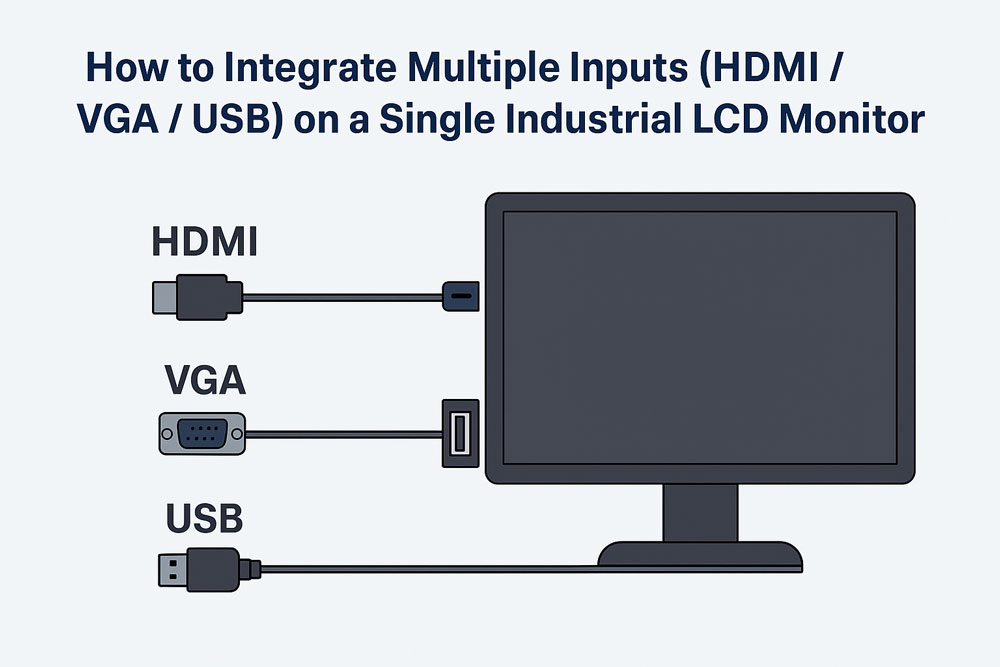
At the core of multi-input integration is the LCD controller board. A professional industrial monitor typically uses a controller that supports:
HDMI, VGA, and USB input channels
Automatic or manual input switching
Signal scaling and resolution management
The controller must be industrial-grade, capable of operating under wide temperature ranges and continuous duty cycles.
Efficient input switching is essential for usability. Common methods include:
OSD (On-Screen Display) menu selection
Physical control buttons
Auto-signal detection
External control via RS232 or GPIO
Advanced industrial LCD monitors allow seamless switching without signal loss, ensuring uninterrupted operation in mission-critical applications.
Industrial environments require robust mechanical design. Input connectors should be:
Firmly mounted to prevent vibration damage
Shielded against dust and electromagnetic interference
Easily accessible for maintenance
Locking HDMI or VGA connectors are often preferred in high-vibration environments.
Integrating multiple inputs increases electrical complexity. Proper grounding, power isolation, and surge protection are essential to:
Prevent signal interference
Protect internal components
Ensure compliance with industrial safety standards
The firmware of an industrial LCD monitor plays a critical role in managing multiple inputs. Optimized firmware enables:
Fast input detection
Stable image scaling
Custom default input settings
Remote configuration in industrial systems
This is especially important for automated environments where monitors may need to restart and reconnect autonomously.
Industrial LCD monitors with HDMI, VGA, and USB inputs are widely used in:
Factory automation and production lines
Industrial control panels
Medical and laboratory equipment
Transportation and traffic control systems
Self-service kiosks and industrial terminals
Their versatility makes them suitable for both new installations and system upgrades.
To ensure reliable multi-input integration, consider the following best practices:
Choose industrial-grade components rated for long-term operation
Test signal compatibility with all target devices
Prioritize EMI protection and thermal management
Design for future expansion and interface upgrades
Integrating HDMI, VGA, and USB inputs on a single industrial LCD monitor is a strategic approach to building flexible, reliable, and future-ready industrial display systems. By carefully considering controller design, signal management, mechanical durability, and firmware optimization, manufacturers and system integrators can deliver monitors that meet the demanding requirements of modern industrial environments.
A well-designed multi-input industrial LCD monitor not only improves compatibility and usability but also reduces system complexity and long-term operational costs—making it an essential component in today’s industrial display solutions.



 IPv6 network supported