
Industrial Displays for Digital Twin Systems: Enabling Real-Time Visualization and Smart Decision-Making
Digital twin technology is rapidly transforming industrial operations by creating real-time virtual replicas of physical assets, processes, and systems. These digital twins rely heavily on accurate data visualization to deliver insights, optimize performance, and support predictive maintenance. At the heart of this visualization layer are industrial displays for digital twin systems, which provide operators, engineers, and decision-makers with clear, reliable, and interactive interfaces.
Unlike consumer-grade screens, industrial displays are designed to operate continuously in harsh environments while delivering high-resolution, real-time data visualization. As digital twin adoption expands across manufacturing, energy, transportation, and smart infrastructure, the role of industrial-grade display technology becomes increasingly critical.
A digital twin system integrates sensors, industrial IoT platforms, simulation models, and analytics tools to mirror physical operations in real time. These systems allow organizations to:
Monitor asset health and performance
Simulate operational scenarios
Predict failures and maintenance needs
Optimize production efficiency
Improve safety and compliance
However, the effectiveness of a digital twin depends not only on data accuracy but also on how intuitively that data is presented. This is where industrial displays for digital twin systems play a vital role, acting as the primary interface between complex data streams and human users.
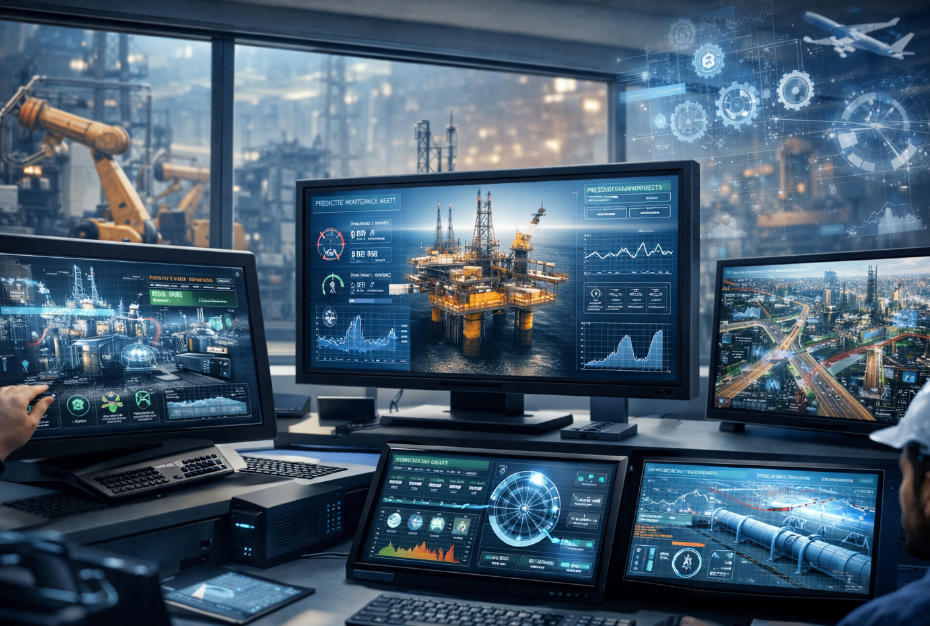
Digital twins generate massive volumes of data from multiple sources. Industrial displays enable real-time visualization of operational metrics, 3D models, and performance dashboards, helping users quickly interpret system status and respond to changes.
High-quality industrial displays support advanced graphical interfaces, including dynamic charts, heat maps, and 3D simulations. This improves situational awareness and allows operators to identify anomalies, bottlenecks, or potential risks at a glance.
Digital twin platforms often operate 24/7. Industrial displays are engineered for continuous use, offering extended lifespans, stable performance, and resistance to vibration, dust, humidity, and temperature fluctuations.
Accurate digital twin visualization requires sharp, high-resolution displays capable of rendering detailed graphics and complex data models. Full HD and 4K industrial displays ensure clarity even when displaying dense datasets or large-scale system simulations.
In control rooms and factory floors, displays must remain visible from multiple angles and under varying lighting conditions. Industrial displays offer high brightness levels and wide viewing angles to maintain readability in challenging environments.
Many industrial displays for digital twin systems incorporate multi-touch functionality, allowing users to interact directly with virtual models, zoom into assets, or adjust parameters. This interactivity enhances usability and speeds up decision-making.
Industrial environments expose equipment to dust, oil, vibration, and extreme temperatures. Rugged enclosures, fanless designs, and industrial-grade components ensure reliable operation and minimal maintenance.
Unlike consumer displays, industrial displays are designed with long-term availability in mind. This ensures consistency across digital twin deployments and simplifies system upgrades and maintenance over time.
In smart factories, industrial displays visualize digital twins of production lines, machines, and workflows. Operators can monitor performance in real time, identify inefficiencies, and simulate process improvements before implementing physical changes.
Power plants, substations, and renewable energy facilities use digital twins to manage complex systems. Industrial displays provide real-time visualization of grid performance, asset health, and energy flow, improving reliability and operational efficiency.
Digital twins of rail networks, airports, and smart cities rely on industrial displays for centralized monitoring and control. These displays help stakeholders visualize traffic patterns, infrastructure health, and predictive maintenance data.
In hazardous environments, industrial displays for digital twin systems enable remote monitoring and simulation, reducing the need for on-site inspections and improving safety while maintaining operational oversight.
Industrial displays are typically integrated with SCADA systems, PLCs, MES platforms, and industrial IoT solutions. Compatibility with common industrial communication protocols and operating systems ensures seamless data flow between the digital twin platform and the visualization layer.
Modern industrial displays also support edge computing capabilities, allowing certain data processing tasks to be handled locally. This reduces latency and improves real-time responsiveness in digital twin applications.
Emerging technologies such as OLED, mini-LED, and transparent displays are enhancing visual quality and energy efficiency. These innovations will further improve the realism and usability of digital twin interfaces.
Artificial intelligence is increasingly being integrated into digital twin platforms. Industrial displays will evolve to support adaptive interfaces, predictive alerts, and contextual visualization based on user roles and operational priorities.
Industrial displays are beginning to work alongside augmented reality (AR) and virtual reality (VR) solutions, creating immersive digital twin experiences. This trend will further enhance training, maintenance, and system simulation capabilities.
When selecting industrial displays for digital twin systems, organizations should consider:
Environmental conditions and installation location
Required resolution and screen size
Touch and interaction needs
System compatibility and connectivity
Long-term availability and support
A well-chosen industrial display not only improves visualization quality but also maximizes the return on investment of digital twin initiatives.
As digital twin technology becomes a cornerstone of modern industrial transformation, the importance of reliable and high-performance visualization cannot be overstated. Industrial displays for digital twin systems serve as the critical interface that turns complex data into actionable insights.
By combining rugged design, advanced visualization capabilities, and seamless system integration, industrial displays empower organizations to unlock the full potential of digital twins. Investing in the right display technology ensures clearer insights, faster decision-making, and more resilient industrial operations in an increasingly digital world.











 IPv6 network supported